
The large, brightly colored homes of Slakterquay’s South Slope neighborhood stood in stark contrast to the gray sky. Pink hydrangeas ringed the small, well tended lawns and window boxes of tulips and bee balm fluttered in the autumn air, the mailboxes bright white near the streets’ black pavement. It looked like a place where children should be playing outside, dogs should be chasing balls, and respectful neighbors would be driving slowly to avoid harming such innocents.
None of these things were present.
There were two figures. One was tall and dressed in black from head-to-toe. The other only matched in that the figure’s hair was as black as the other’s dress. Slight as well as diminutive, the shorter one wore a tailored, wool suit as gray as the Northwest sky that hung over Slakterquay, with skin pale enough that it stood out against any color the neighborhood possessed. Both stared at a dwelling that looked like none of the others in the neighborhood.
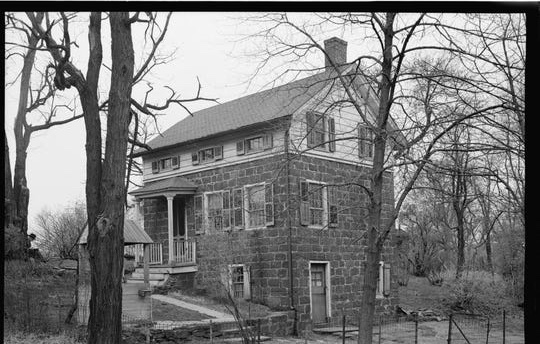
Standing on the corner of Coves and Rattler, the house they observed was three stories of weathered gray stone, with patches of lichen and moss clinging to its face. Darkened windows spotted it at irregular intervals, the highest alone near its peaked roof. The eye bent around the house’s frame, as if gravity pulled the viewer’s gaze along the incline of the street.
“There’s no reason that house should have permits to function in this community,” the tall one on the corner said to his short companion. “It’s a business operating in a residential neighborhood. Technically, that’s only allowed with special dispensation.”
The short one stared at the boarding house intently, smiling like the devil. “And…?”
Korbin glanced at his associate, which mostly gave him a view of the top of her well-coiffed hair. He breathed a deep sigh and flattened out the front of his lapels, “McPherson, do you have to enjoy this as much as you are?”
Aggie McPherson continued to smile. “You don’t bring a spectral analyst to look at a boarding house because it’s operating without the correct permits. This place looks old enough that it could have been grandfathered in.”
Korbin countered, “I’ve checked the files down at the city clerks office. There aren’t any permits on record.” When McPherson only turned a cocked eyebrow at him, he continued with, “The house might as well not exist.”
The inspector pushed the hair out of her eyes. “And yet it does.”
Korbin took a long breath, knowing Aggie was relishing this. “Clearly. However, no one remembers it being here.”
McPherson chuckled, looking up and down at the block with its very fine homes, luxury cars in driveways. Korbin sighed, sensing the analyst calculate how much she could gouge from the homeowners for her services. Instead of talking terms, though, the diminutive analyst asked, “Anyone remember when it appeared?”
“No. It seems as if it’s always been there, but no one remembers seeing it when they moved in.”
“You say it’s a boarding house?”
“If we get closer you’ll see a small placard in a window stating rates. $1 a night.”
McPherson’s eyes brightened so that Korbin could sense it without even glancing at her. “That’s impossibly cheap.”
“Indeed,” Korbin agreed. “As you can imagine, it’s attracted all sorts of unsavory types. Strangers moving in and out of the neighborhood on a regular basis. Men the people here never get to know but live near their children before departing to parts unknown.”
McPherson turned a critical eye onto Korbin. “Are you saying that no one noticed the house until they saw vagrants moving in and out of it?”
Prepared to receive the analyst’s usual commentary on the human race Korbin equivocated. “I wouldn’t call them vagrants, necessarily.” McPherson laughed then, musical, like something one might hear from behind the bushes in a secret garden.
Before he could respond McPherson’s mouth snapped shut and she practically trembled with anticipation. “Korbin, you do bring me the very best strange. So who’s spoken to them?”
“I’m sorry?”
“This is a high class neighborhood, Korbin. The plot of land that house sits on is worth a small fortune. Surely someone has gone in to talk to the owner?”
Korbin glanced around at the quiet neighborhood, wondering what McPherson had deduced that from. “A few of the residents have. I understand a few realtors have as well.”
McPherson stared up at her taller companion, batting her eyelashes ridiculously, urging him to continue. “No one has ever noticed the fate of the realtors,” Korbin continued, eliciting a shrug from his compatriot. “The residents have come out, but…different.”
McPherson ceased her ridiculous mugging to find some empathy for the street’s residents. “Different how?”
Korbin paused. “Just…different. They’ve uniformly changed their mind about the boarding house, saying it’s a good thing. Unwilling to discuss it beyond that, but some of the wives have noticed their husbands sneaking back to the house at odd hours.”
“All husbands? No women?”
“Well, the first person to go in is a woman. Anne Derby. Her husband hired me.”
“Why?”
“She hasn’t come out.”
“Why hasn’t he gone to the police?”
“I don’t know. He seemed,” Korbin paused, then abandoned his attempt at diplomacy for the truth. “Afraid.”
“Of the house?”
“No. Of embarrassing his wife. Police showing up in South Slope to investigate a house no one remembers would cause a scandal.”
From her lower height, McPherson somehow managed to appear as if she were looking down at Korbin. He only lifted his shoulders closer to his dark head of hair in a shrug. “Or so I’ve been told.” He pointedly stared at a nearby home where a figure could be seen standing behind the curtains of a bay window.
Under that shadowed gaze, Korbin reflexively tightened as he felt Aggie put her arm through his and began to walk towards the boarding house. With his greater height he was able to stop her, but with what he found was a surprising amount of effort. “What are you doing?”
McPherson laid her devilish smile onto Korbin. “We’re going in, of course.”
“Why would I have brought you here if I wanted to go in?” Korbin attempted to remove his arm from the inspector’s grip. She held on with enough strength that forcibly removing himself would have cost each of them their dignity.
“Mr. Halvorsen,” McPherson said his last name with emphasis, “You wouldn’t let a slight individual such as myself go into a house filled with ne’er-do-wells, would you?”
“McPherson,” Korbin countered with his own intensity, “the residents contracted me to find a solution to their problem. I found you.”
McPherson waggled her eyebrows in a way that Korbin thought might have been meant to charm, but only added to her impishness. “Yes, you did. And as a part of the conditions for my services I’m going to require that you come with me.”
Korbin smoothed the ruffles McPherson’s grip had put into his jacket as a way of avoiding her gaze. After a moment, “Fine. I’ll assist for a percentage of your fee.”
In a tone so serious that Korbin knew he was being mocked, McPherson replied, “Haven’t the residents already paid you to find a solution to their problem? Couldn’t taking a percentage of my fee be viewed as a kickback?” She winked at him. “Wouldn’t that be considered a breach of your ethics?”
Korbin frowned, unhappy with this logic but unable to contest it. He straightened himself to his full height to make this as awkward as he could for this associate. “Very well.”
With confident strides Korbin led the way to the stone house as if this had been his idea all along. In truth, he was beginning to wish he had called Detective Fel instead of McPherson.
The front entrance was a solid wood door which had survived the weathering and scratches of age even if its paint had not. There was no doorbell, but a bronze knocker.
Releasing his arm, McPherson rapped on the door and, when that received no response, rapped loudly with the knocker. They waited.
“Well,” Aggie said in a huff, suggesting someone was being very rude. She reached for the doorknob. It was then that it cracked open and a small, yellow eye peeked from the darkness within the house.
“Oh, good afternoon.” The door swung open revealing the eye belonged to a stolid woman, blonde hair done up in a bun and sun wrinkles on her square face despite its paleness. Her slight frame was covered in a patterned dress under a sturdy apron. She smiled, the expression missing her eyes, which appeared as bright as the leaden sun that fell upon her. “My apologies. I was downstairs cleaning.”
Korbin paused on the doorstep, feeling he recognized the woman. In that silence, McPherson issued a warm greeting and stated, “We were hoping to find a room for the night.”
The woman rose up to a matronly stance and examined the inspector carefully. An uncertainty crept into her friendly tone as she said, “I’m afraid we only cater to single men in this house.”
“Of course,” McPherson replied, smiling still, but Korbin became aware that her demeanor had changed. McPherson was now feet instead of inches from Korbin. The woman’s eyes narrowed in an examination that Korbin was quite sure he would have wilted under, but the McPherson’s smile remained unchanged, her stance unshaken.
“My apologies. Please come in,” the hostess replied as she stepped back, opening the door wider to reveal a large foyer. Aggie led the way while Korbin paused at the threshold, struck by the oddity of the central room.
It was lit as if it was the darkest night outside, with several sconces throughout. To the far right was a stairwell that bent around the corner of the room to wind up and down to unseen levels. Next to it was a small, fixed desk, with a large registry on it that looked like it was acquired from an antiquing expedition. Aside from the desk, stairs, and door frames, the room was constructed of perfectly fitted, if irregularly sized, stones. The left side was only interrupted by a large framed picture of a man wearing a black frock coat and vest, atop which sat a large bald head pale as a fish’s belly, adorned only by a walrus mustache that the best it could to cover his face.
The portrait didn’t quite sit straight in its frame which, when combined with the bending stairwell, set the entire room askew. Entering the house, Korbin felt as if were walking at a slight angle.
The woman and her bun bobbed behind the desk where she picked up a fountain pen, hand resting over the large open registry. “How many nights will you be staying with us?”
McPherson craned her head, taking in the room in as she answered. “Just one night.”
“Delightful. Two rooms for one night then?”
The inspector’s eyes snapped onto the older woman. “I’m sorry, I didn’t catch your name?”
The sternness from before returned into the proprietress’s gaze, making Korbin hesitate in closing the door behind him. She stared directly at him, though, making him feel as if he had little choice. When the door clicked shut, she responded, “Lillian Clark.”
“Nice to meet you, Ms. Clark. And who is this fine gentleman on the wall?”
Clark set down her pen, a smile blooming from her wrinkles. “Jeremiah Naugle. He’s one of our founders.”
“Of the house?”
“Oh yes,” Clark tittered in a way that made her sound like a schoolgirl with a crush. “But I meant the city.”
“Interesting.” Aggie studied the portrait causally before adding, “I thought I knew Slakterquay’s history, but I’ve never heard of Naugle.”
Clark became ramrod straight, only bending her neck to find her pen again. “Well, these days, not everything that’s true makes it into the history books.”
McPherson snorted, worrying Korbin that she might be ridiculing Clark. Instead, McPherson agreed, “That’s certainly true. What was his contribution? To the city, I mean.”
“Oh, that goes back a ways.” Pen in hand, Clark floated it above the registry’s pages as if tracing a route on a map. Korbin found himself watching it rather than his partner. “The South Slope wasn’t even a neighborhood when this place was built. This was just a lodge he built for communing.”
“Communing?”
“Yes. A decent place for men to come together: Trappers, miners, dockworkers. He even invited in some of the natives. A safe haven for all.”
“Natives. You mean the X’Komish?” Uncomfortable with McPherson’s invoking the name of Slakterqay’s indigenous people, Korbin turned to studied Clark’s reaction.
He saw the matronly sternness of her expression was replaced with a mild confusion that caused her to tap the pen on her chin. The gesture along with her laugh made her appear younger, as well as more familiar. “No, I don’t think that was their name. But he built this lodge to commune with them. Of course, that was a long time ago. Now his home serves as a humble place to give travelers a safe place to rest.”
“Is that a fact?”
“It is. Some people who stay here even say they dream of him.” Korbin blinked and found himself staring into Clark’s yellow eyes, the woman no longer behind the desk, but only feet from him. “Do you?”
Korbin took a reflexive step back. “Do I what?”
“Dream?” Clark asked.
Looking around the room, Korbin tried to locate McPherson, but answered, “I’m sorry, I seem to be out of sorts.”
“That’s alright, dear.” Clark took him by the arm and guided him toward the front desk. This close, he found her familiarity only increased. “Why don’t you sign in and we’ll get you someplace comfortable to rest.”
“Yes,” McPherson’s words caused her to reappear as if she had summoned herself. “Why don’t you? I’ll find other accommodations.”
Korbin and Clark spoke at the same time. “What?”
“I’ll need to find other accommodations.” McPherson spoke to Clark. “You said only single men stay here.”
Clark examined McPherson more closely, the features on her square face slowly arranging themselves into downward vectors. “My apologies. I didn’t realize.”
To Korbin’s increasing alarm, McPherson replied, “That’s no trouble. It happens all the time.”
Aggie shrugged while Korbin stared at her, trying his best to telepathically signal that her departure wasn’t welcome. He pulled himself from Clark to ask McPherson, hand on her upper arm. “Where are you going?”
“Oh, now Korbin, a big strong man like you should be fine.”
Korbin lowered his voice to nearly a hiss. “McPherson, I recognize our proprietress. She’s Anne Derby.”
The analyst pried Korbin’s hand from her bicep. “Then I guess I’ll start by letting her husband know we found her. Won’t he be thrilled?”
Thinking of the photo Mr. Derby had shown Korbin of his wife, it was difficult to think that he would be overjoyed by the news. The woman behind the counter appeared to have no recollection of who she was, but now that his mind had hit upon it, the resemblance was unmistakable. “That wasn’t our agreement.”
Aggie finished pulling his fingers from her blazer, looking irritated that he had wrinkled the costly fabric. “I’ll be back,” she reassured him.
And it almost did. Right until the door closed behind her and Korbin heard Derby speak from behind him. “Now, why don’t we get you signed in?”
To read the next chapter, go here.
See author’s published work here.
Related Posts
-

The Case With No Client, Chapter 3
-

The Case With No Client, Chapter 2
-

The Case With No Client, Chapter 1
Suddenly, the Weather Next Post:
The Khan Receives