Image courtesy of ropen7789.
“My great-grandfather died of syphilis.”
Gerard Calvaire feels the intended shock of this statement land, and seeing the perverse smile stretch across the face of its speaker, he doubts the truth of it. Across from him, in a directors chair, sits Kate Watson, CEO of Bennu, most promising young chief executive in Silicon Valley. And Gerard is almost certain she is lying to him.
Both of them sit on the stage side of a dark curtains and they can hear the audience milling beyond its muffling border. The crowd is here to listen to Ms. Watson’s latest bio-tech product announcement and they fill the auditorium with an anticipatory buzz. Gerard has attended many such events and is fully aware of Ms. Watson’s charismatic reputation. Yet still he feels the electric jitters of excitement.
He tries to calm this nervousness by sussing out Ms. Watson’s statement about her lineage. “Your grandfather dying of syphilis caused you to start up Bennu?”
Watson’s smile seems to grow, if possible, wider. “Yes. It was a family secret, something that had carried three generations of shame. I only learned of it just before I left for Stanford.” Watson settles back in her chair, pulling a knee up with both hands. “I didn’t see a reason anyone should die with secrets or shame, so I launched a diagnostic company that people might be able to test themselves, in private, and seek the correct therapy as a result.”
Gerard puzzles at the young woman, feeling his own jealousies at her youth and talent calmed by the knowledge of her dishonesty. “But syphilis is a bacterial disease. Bennu focuses on viruses.”
“Out of necessity. The pandemic broke out shortly before Bennu began making its initial tests available. Naturally, the public at large was much more concerned about that, so we have pivoted our strategy to viruses. The incompetent response of the central government necessitated it.”
Watson volleys a smile with her reply, slow and easy, giving Gerard plenty of time to think. It also gives the older journalist the impression that if Watson knows Gerard suspects her of lying, she doesn’t much care. She must think she’s very clever. He decides he’ll finish this publicly. “Thank you, Ms. Watson. I’ll ask the rest of my questions with the other press from the announcement floor.”
Rather than the uncertainty or concern Gerard thinks this unorthodox decision will cause, Watson’s eyes sharpen, like a bird spotting prey. “Certainly. I look forward to it.”
Silhouetted security figures detach themselves from Watson’s side and glide to Gerard, escorting him through the backstage darkness. Drapes to the side part and Gerard steps through into the overhead lights of the auditorium. He can feel the professional envy of his colleagues burn even through their remote attendance for Gerard having secured an exclusive interview. Before stepping down from the proscenium, he baths in the light and that resentment, savoring the knowledge that the best is yet to come.
The crowd in attendance, even insulated as they are through massive wealth and confidence, still maintains social distancing, resulting in a much smaller group than would normally attend such an event. Most are investors there with a hunger to see how their young protege has turned the pandemic into profit. Gerard, excited for his own reason, can feel the collective hunger of the shareholders, as they begin to file to their seats. Before the pandemic, Watson’s idea had already attracted interest, but with its potential for curbing, or even possibly developing an antibody-based cure, for the disease, untold fortunes had flowed in. Watching them, Gerard can’t help but smile. He almost hates to ruin it for them.
The crowd settles and Watson steps out to applause. She wears head-to-toe black as if she had wrapped herself in the backstage shadows before coming into the light. She smiles, and Gerard shivers, the same predatory shade as before passing over him. He shakes it off, though, assuring himself it’s only nerves, and that his moment in the spotlight is close. He waits, certain it is ineluctable.
After some standard boilerplate remarks that Ms. Watson inflects with her usual magnetism, his moment arrives. She holds up a vial of blood so bright it could be blue. She gestures it to with her other hand, indicating the tube as if the container was all the proof that was needed. “When infected blood reacts with the reagent, it changes to this unmistakable color –”
Gerard chooses that moment, before press questions are even meant to be allowed, but a sizable bribe to the sound operator has guaranteed his mic is live. He stands, holding his smartphone out in front of him like an old digital recorder. “Ms. Watson?” Gerard had intended on plowing through into his questions, but finds that with all eyes on him, he stops.
The pause in the room is palpable as it hardens into expectation. Before that becomes hostility, Watson speaks, as if granting him permission. She says, cordially, “Yes Mr. Calvaire?”
Gerard finds his voice. “Are you aware that Dr. Peter Yannis of the New York Health Department has recently made the statement that Bennu’s peer-reviewed research has been fabricated?”
The question causes mutters to stir through the crowd, its ripple pushing many of the investors to rotate from Gerard to the stage, eyes demanding an answer. Some of the investors, Gerard notes, do not look to the stage for answers, but appear to be eyeing the exits.
Certain that his microphone will be cut at any moment, Gerard presses on. “In fact, a recent study by the University of Toronto reported that the method’s used by Bennu were, and I quote, ‘scientifically and factually erroneous.’” Gerard holds out his phone higher, closer to Watson, attempting to suppress a smile as he lines it up with her profile, setting its sites on her. “Could you please tell this audience what that might mean for the future of Bennu and its investors?”
A lapidified moment settles on the crowd as everyone waits for Watson’s response. The room grows perceptibly warmer, as if in collective blush. Gerard waits, unable to hide his smile as the seconds tick by, waiting for Watson to break out into angry refutations, denials, or perhaps just tears.
But then, Ms. Watson returns Gerard’s smile and he feels his own falter, for her visage contains a benevolent affection that makes his own feel brittle. “Thank you, Mr. Calvaire.”
The simple words dumbfound Gerard, as unexpected as they are. He betrays decades of professional experience when he drops his phone – he watches Watson step off the stage and into the crowd. It takes Gerard a disbelieving moment to accept that she isn’t off the stage, but out into the air in front of it, still suspended above the crowd, nothing under her feet but invisible stairs. She steps forward and up, the heat in the room rising with her.
Gerard hears something like a soundless klaxon commence in his head, an alarm bell telling him to flee. Like the investors, though, he is rooted in place, for when Watson speaks again, it is undeniably clear that she is standing above all of them, unaided by anything but atmosphere. “I’ve been waiting a very long time for this moment, but couldn’t have gotten here without all of you.”
As if in a belated response to her levitation, golden feathers begin to sprout from her back. “I’ve lived a long time, ladies and gentleman, longer than any of you might have even begun to suspect. But as all of you have learned, no one lives very long without sacrifice.
“From millennium to millenium, I have been born into new life by arising from the ashes of the old one, consuming myself in a fire that was told of throughout legend.” Gerard, mouth agape, watched as Watson rotates above the crowd, a golden crest splitting her hair as it rises from her head.
“But as the modern world dawned, with all its little bullhorns and noise, I realized it wasn’t the fire that allowed me to be reborn, but the story of that fire. Ptahhotep, Herodotus, Lactantius, Pliny the Elder, Ovid, Isidore of Seville – all of these greats had at one point helped transmit my story.
“Even your most influential only hold a fractured span of attention compared to them. So I realized I needed a new story, one with a new fire that would burn bright enough that the world would talk of it.” The room now, was unmistakably warmer. Gerard felt sweat push from his skin and then evaporate into the air. Her wings fully spread, Watson’s clothing falls away from her body like chipping paint.
“And all of you helped me find it. Now here we are, with all of you in this room so eager to hoard more money that you barely examined my claims. All it took was a little sleight of hand, a little charm, and the promise to satiate your greed, and I bent reality around you, made you see what you wanted. How much time and money have been heaped upon the bonfire I called Bennu? How much has been sacrificed in my name?” As she speaks, the investors scramble, kicking over chairs on their way to attempt opening the fused exits. Many begin to scream.
Watson’s wings expand, her light grows, the heat of the room becomes unbearable. Gerard knows he himself is on that pyre. He finds his voice. “No! I don’t belong here! I was here to expose you!”
Watson smiles down on him, her teeth proliferating and elongating till they form a beak, yet she speaks with a voice most human. “Yes – for your own ambition. You could have exposed this farce months ago, saved untold riches. Yet you did not. Because you wanted more that the truth. You wanted fame, approval, recognition, money. All things there would have been better ways to get.”
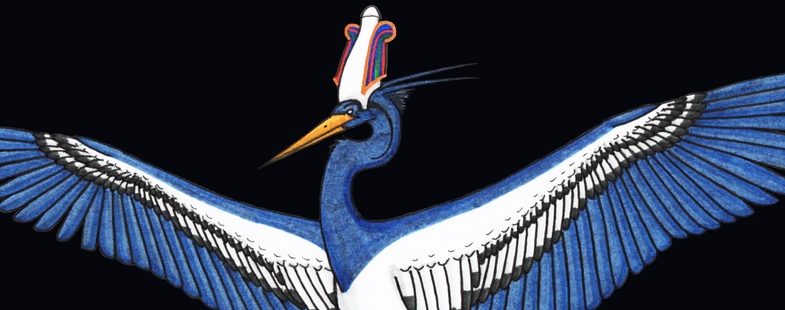
Gerard feels light in his eyes, the wallpaper burst into flames as the heat reaches a critical point, and he hears the voice of something as ancient as the avarice in his heart. “No, Gerard Calvaire, you belong here most of all.” Watson rises to the peaked zenith of the room, her human vestige falling away, becoming something else, becoming Bennu.
Then the room burns.