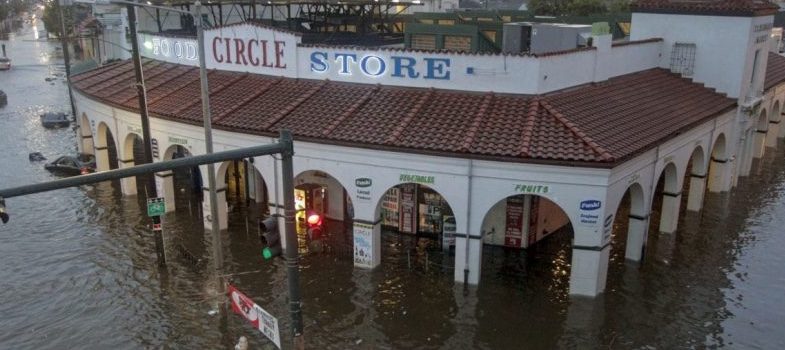
The bakery flooded in the sixth day of rains and left Marjon without a living. When the levee on the fifth district broke, the water came flooding in through the basement windows fast enough that it knocked over the bread racks, inundated the ovens, and sank the cashbox.
She grabbed two of the two loaves she had made with her own hands and held them above her head as she fled. She kept them dry there even when she crossed water so deep she had to hold up her chin to keep from drowning, past fleeing rats and debris so wet and dark it was impossible to tell what it was.
Marjon finally made it to the higher ground of
the sixth district and sold the two loaves to a man who paid a fair price with soaked currency. He gave her one loaf back and gestured for her to eat, and the two sat on what was now the embankment of the district, watching the detritus of their lives and the lives of their neighbors float away.
Chewing methodically, the man patted himself down in the way people do when they have forgotten something. When Marjon looked at him questioningly he said, “I lost my keys.”
Select the play button above for an audio reading.To see all chapters, go here.
The security office also had a board with everyone’s schedules. I checked it to see what sector I was stationed in, then took a glance to see Jasper’s break schedule. That information in my pocket I went to the oubliette of the slot machines to wait. Other than answering the questions of a little old Greek lady, my shift passed with its usual boredom.
It was easy enough to get from the dark of the slot machine sector to the equally dim backroom without passing through the manufactured glamour of the main halls, although walking through the marble and velvet would have made a nice change. Outside of the bathroom and at least one of the changing rooms, the security break room was one of the few places in the casino with no cameras. I’m sure that wasn’t a coincidence.
The room did have a round, cameo window, hanging at head height like a porthole. The first time I passed by I peeped through it to see Jasper wasn’t alone, so I kept walking. The second time he was so I pushed all the through the door and in. Like all of the internal rooms of the casino, the grey walls of the break room were windowless and undecorated. Jasper sat alone with his bow tie and crisp white shirt at one of two long, wood laminate tables. With a small cooler and a few pieces of sliced apple in front of him, he could have been a schoolkid eating his lunch alone. Except, like most of his co-workers, I’m sure schoolkids around here went home for their lunch breaks.
For a moment, I felt something like pity lurch in my chest, some misbegotten beast that wanted to stagger towards Jasper. But I beat it with each of my few steps to him, my familiar contempt of the small man taking over by the time I sat myself at the table.
I don’t think any of that showed on my face, but there was a wariness around Jasper’s eyes as he gave me his unctuous grin. He said it was good to see me and I nodded. I annoyed him for a few minutes by butchering his language in a series of mundane questions meant to sound like I was trying to make small talk.
“Thanks for pointing out the high roller the other day,” I lied, hoping to make it seem that I didn’t understand Jasper’s actual motive.
His smile told me I was at least partially successful. He replied, “It made for a pretty exciting evening. Lots of talk in the back room for many hours.”
“Yeah,” I nodded, sneaking a glance to the break room’s entrance, appearing as a man who doesn’t want to be caught. “I was hoping to keep that from happening again.”
Jasper grinned as men do when they’re certain they know more. “I don’t think he’ll be coming back after what happened with Sarti.”
“Yeah, but they’re trouble,” I said, taking out a few of the hundred Euro marks I had brought with me, keeping them in my fist. “I was wondering if you could keep an eye out for me.” I peeled off two of the Euro c-notes.
Jasper tried hard to appear offended, sharing his fellow continentals’ affected disdain for money, but I noticed he kept glancing down at the currency, noting there was still more in my hand. “That is already my job – but I do it for the house.”
“Absolutely.” I peeled off a third Euro, slipping into English. “And I don’t want to get in the way of that. But I was wondering if you could let me know about anything unusual. New faces, familiar faces doing new things. That sort of thing.” I pushed the money across the tiger stripes of the fake wood towards Jasper.
He chewed on his apple, still staring at the money without taking it. “Why would I do this?”
I hesitated to point out that he had done this very same thing the other night without me asking for it, but I didn’t want to overplay my hand. Instead I replied, “The Beard might be involved in human trafficking. Casino management doesn’t want to get involved, and they don’t want it around either.”
Jasper stopped chewing his apple, tucking it into his cheek so he could speak. “You’re working for Sarti?”
I let my face fall into a dead blank, as someone who’s remembered his poker face. Instead of answering I just pushed the cash towards him. “I can’t say.”
Jasper smiled more broadly, tonguing the rest of an apple slice into his mouth. He slid the money off the table then replaced it with one of his feet. He leaned back, unfurling himself like some kind of supercilious caterpillar. “Sure. I can do that for you.”
“Great.” I tried to smile in a way that I hoped hid my impulse to slap his feet off the table. Echoing Mitnick in a way that I wasn’t entirely comfortable with I added, “If you spot anything useful there’ll be more where that came from.”
His face screwed into a rictus of confusion while he sorted through my last sentence’s structure and contractions. I was fairly certain he wasn’t just pretending to understand when he nodded. I got up and left the blank walls of the break room, feeling like a man escaping a submarine before the waters rush in.
Walking along the steam pipes and moving through the shadow and light of each dim light fixture, I wondered what I was doing. I couldn’t tell if I was betting on Jasper seeing something and telling me, or if I was betting on his inability to keep his mouth shut to bring something out of the woodwork.
The wax on the candles had begun to run a little long before Max had even begun to question his plan. He was meant to be out of town, but had gotten back early, early enough that he could get into the apartment before Lisa would get off work. Struck by inspiration from the frayed edges of their relationship, he ordered a to-go meal from her favorite restaurant, unfurled the tablecloth, laid out the candles. But she was late, and he was still waiting, left to wonder what an unhappy wife got up to while her man was out of town.
He dodged into the closet when he heard her finally buzz in, the walls so thin you could hear everything from the adjacent stairwell. Over her footsteps her voice carried up to him. She was speaking to someone and, for a moment, he imagined that he had caught her with an illicit lover, his surprised turned disaster. The conversation, though, was one-sided, and he breathed a sigh of relief, realizing she was talking on her mobile. “And you’re sure?” she whispered as she entered. The door closed, she added, “I just slip this into his food and he drifts off?”
Max stayed in the closet, piecing together what Lisa was saying as she rounded the corner into the kitchen, her last words out before she saw his surprise, “I don’t want him to suffer.”
Select the play button above for an audio reading.To see all chapters, go here.
I managed to catch a tram before it began to rain again, hopping off long before I got to the casino. None of the trams went directly from the poorer quarters into the heart of the old city. A chain of tram stations formed a periphérique between the outer banlieue and the luxurious homes, tourist hotels and Promenade of the central city, with its orange roofs and port filled with yachts baking in the sun. Whether you hopped onto another tram or went on foot, it gave the gendarmerie, standing around in body armor and rifles, black as old knights, plenty of time to look over the crowd, trying to pick out the next thief or friend of Tariq’s. I had learned that even my light skin didn’t keep me from scrutiny, the eyes behind masks boring into me as I walked by. I didn’t make eye contact and moved on.
I had been thinking about how long Mitnick’s boys might have been watching me and if they might have seen Atwell pick me up. I decided if they had, the Beard wouldn’t have wanted to talk to me, so I didn’t want to be as clumsy or obvious as Atwell if I could help it.
Walking from the tram station I took a relaxed, circuitous route, sticking to the pedestrian streets as I meandered to the southeast, heading back towards the harbor and promenade that cradled the casino. The bustle of early season tourists made it easier to spot anyone who might have been a tail, most folks moving in solid, direct lines, going from A to B. Instead I took a quick turn here and another there ending up at the cathedral.
A massive Byzantine structure that sat on a Greek Cross plan, the basilica had all the spikes and arches that someone a long time ago had associated with God. I always thought is was some kind of joke to Atwell having the dead drop there. The stone structure didn’t bring up any memories of the catechistic education of my youth, though. Instead its stone towers and onion domes always reminding me of minarets, half evoking the long, lonely call of the muezzin whenever I came into sight of the church.
Whatever the church reminded people of, it drew their attention, so across the street and just around the corner was the perfect place for the dead drop. An old telephone booth stood on the corner, a glass box that looked like something Superman would have changed in, but cracked and stenciled with graffiti, browned like a smoker’s teeth. I took a few moments to chew a piece of gum and dial a fake number, using a dry erase marker to write out the note, simply stating, “Made contact.” Waiting for the husky, automated voice of the phone sex line to pick up and ask for a credit card I doodled on the phone booth’s glass, leaving a tally mark to signal that there was something for pick up. Sticking the gum to the note I slapped it underneath the phone and got out, briskly walking away as a man who’s concluded his business.
I spiraled away from the cathedral, circling back to make sure I was still clean from a tail, then hopped on another tram to the casino. It had begun to rain again before I stepped off, reminding me of the umbrella and to be grateful for it. Relatively dry by the time I got inside, I put on my blazer and headed deeper into the casino’s gray interior, over to the security office.
The office was small, but well-lit, windows high in the walls. Reconstituted wood from the old barn that had once stood in the airfield lined the walls and desk, the color warm and reddish. As the head of the ‘Found Property Office’ at Majorca’s sole airport, Busby had been the purveyor of relief and disappointment for over 15 years, handing travelers back their prized possessions or the news that no thing fitting their description had been found.
It was mostly mundane items, jackets and glasses and briefcases, but he had also been witness to the extraordinary: a bag of glittery stones that surely could have been diamonds; a portfolio of intimate photographs of the famous; a carrier with the baby still in it, the mother so exhausted that anything but her own fatigue had ceased to exist. Busby had treated all as he thought they should be, as prized possessions that surely someone would return for once they discovered their absence.
He had never, though, been left with with a pocketbook that appeared to consist solely of a person’s identify – passport, license, something called a social security card, business cards, photographs, even a birth certificate and marriage license. A valuable treasure trove of materials to prove to the modern world that you are who you claim to be. Busby locked this away in a small safe for such things, certain that the woman who belonged to them would show up, her desperation being replaced with gratitude when she realized her documented self was safe.
Part of Busby, though, couldn’t help but imagine the sandy-haired woman in the pocketbook’s photographs intentionally departing from the airplane without her baggage. He pictured her striding forth, departing without her assemblage of individuality, striding freely into a world made new by her leaving on old one behind.