Select the play button above for an audio reading.
The attic was stuffy with summer heat. It reminded Charles of days spent at his grandfather’s, searching through the detritus of his past, things the old man had relegated into his dusty garret. There was a wooden walking stick that looked like it could double as a weapon with its sharpened point. A pair of black binoculars in their worn case, an old brass theodolite separated from its tripod. When Charles found a journal filled with indecipherable math and survey coordinates, he became convinced his grandfather had been a wizard.
Now, years later, searching through his own father’s home, Charles didn’t see any pictures of his grandfather. None alone or with his father or with any of his siblings. He realized then, that if his grandfather had been a wizard, his one trick had been to disappear.
To start at the beginning go here.To hear an audio reading of the chapter, hit the play button above.
We left Lanzo with Sartre and a reminder to meet at the Distributeur International warehouse the next evening. The two had matters to discuss; funeral arrangements for Moreau and whether to involve the police.
I had Atwell drop me off at the telephone booth near the cathedral. I used it to check the messages on the mobile and was happy to see there weren’t any. That meant Rotella and me were still on to meet Mitnick tomorrow afternoon.
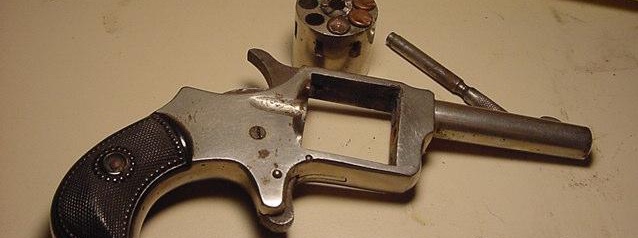
Back at the tenement, I climbed the stairs, kicking trash out of my path and pumping my legs to clear my mind. When that didn’t work, I sat down in the apartment to inspect the revolver.
I had it disassembled and laid out on the coffee table when Sophie arrived home. She breezed in with her quiet grace, standing at the coffee table before I really knew she was there. By way of greeting, she said, “You are on the map.”
Startled and confused, I followed her gaze to the table and realized her map of the brothels must be under the tablecloth. Not a particularly complex way to hide it, but simple and effective. I nodded and began to scoop up the pieces of the revolver into the dishtowel they were on. As if remembering some point of protocol, Sophie bent over from her great height and kissed the top of my head as I moved out of the way. Closer now, she noticed the black metal pieces I was working with and asked, “What is this?”
“It’s a pistol.” Sophie stared at me, her level gaze telling me she was expecting a more in-depth answer. “It’s broken. I’m trying to fix it.”
Sophie’s eyebrows went up and the corners of her mouth went down indicating some perverse interest. “Can you?”
I shook my head. “The firing pin is busted. Without a new one, I can’t.”
“Where would you get this?”
“No idea. If we were in the States I could pick one up anywhere.”
“But you are in a civilized country,” Sophie replied with the wriest of smiles.
I pulled the tablecloth up, revealing the map underneath with its scattering of dots. “Yeah. Civilized.”
Sophie didn’t need to look at the map with its pink and blue to understand the jab. “You have a point.”
As she moved to sit in front of the map I asked, “So how’s it going?” Pulling solely from her memory of the last 24 hours, she began to color in new circles. Watching the muscles in her back move as she dug the pen into the paper, I heard Cheryl whistling a low, idle tune, something she did when pretending to ignore the obvious. I resisted the urge to tell the imaginary incarnation of my deceased wife to shut up.
Fortunately, Sophie put actual sound into the air by answering, “It has been busy.”
Watching her dot the map, almost all in blue, one after another, I said, “I can tell.”
Whatever depravities Sophie had witnessed in her travels across the city had clearly not improved her mood. She continued to work in silence. Her usual graceful curves became sharp angles as her jangled nerves flowed into her scrawling.
I thought about asking her more questions about her investigations. Instead I remembered the inspector and my promise to him. “I spoke with the cop, Rotella.”
“Si?”
“He’s going to help me get a message to Nika. To get her out. I offered him a copy of the map in exchange.” This sparked enough interest in Sophie that she lifted her gaze to me. “He wants to bust open Mitnick and Sartre’s operations. I figure we let him. We just have to time him right.”
Sophie leaned away from the map and into my American-sized indentation on the couch. She idly placed the pen she was holding to her lips, eyes resting on me. “How is he going to see Nika?”
“Mitnick wants to meet him. See if he can be bought. Somewhere in there we’ll get her a note that Lanzo wrote to her. Tells her where and when to meet.”
Sophie tapped the pen twice against her lips. “How will this happen?”
“We’re meeting at Mitnick’s place. Nika should be there. Rotella’s going to say he needs to talk to her if Mitnick wants him to play ball, that he’s heard rumors she’s being held against her will.”
Sophie blinked as the implausibilities started to pile up. “Then how will she escape?”
As usual, Sophie had managed to isolate the weak spot in any plan. “Well, that’s up to her. She did it once before.”
Sophie arched an eyebrow. “Before she was let out to play. Now the man who allowed this is dead, newcomers from the old country swarm the city. They will not simply let her go.” Sophie’s own considerations caused her to lean forward, rapping the map in pangs of thought. “Mitnick’s home is far from town. How will she make her way to the city?”
Sophie was pointing out a series of uncertainties I had been glossing over since speaking with Rotella. Not particularly pleased at having my brilliance questioned, I replied, “She’ll have to figure it out.”
Sophie smiled in the same way as when she had first asked if she should visit Mitnick. “I will go with you.”
“What? Where?”
“With Rotella. To visit Mitnick and this Nika.”
“Mitnick isn’t expecting anyone else.”
Sophie leaned back into the couch again, this time languidly unfurling her long form, the curves of her body stretching the light sweater she was wearing. “Do you think he would mind a visitor from such as me?”
“Yes,” I said emphatically, “I do.”
“Then you will tell him I am an associate of Rotella’s. He wishes me to speak with the girl.”
“What if someone recognizes you from the party?”
Sophie raised a sardonic eyebrow. “Rotella is the first police to consort with lucciola? We will merely say that I am a…” She paused as she found the English words she was searching for, “A professional friend.”
“And you think that Mitnick and his people will just accept this?”
Sophie returned to her map with a simple, “Si.”
Sophie’s insistence on coming along had supplanted the rancor she had brought home with her. I sat down next to her on the couch, the resulting rocking taking her attention away from the map. “If you’re going to come along we’re going to have to nail down some details.”
Vagaries always allowed Sophie to play the mysterious card, to avoid commitment, to allow a sphere of control that she never had to explain to anyone, including me. So forcing her to sit and talk about details was perhaps one of her least favorite things. But we did talk – we talked about the map, the Inspecteur, and how she would get the note to Nika. How Lanzo might bring her to the hutch.
We walked through it as carefully as setting up dominos, with Sartre and Mitnick at one end. In the middle were the police raids on the cathouses. At the finish were Lanzo and Nika disappearing under the resulting cloud of war.
Realizing we might be up late, I went into the kitchen and made some coffee. Sophie hummed happily on thecouch until I heard Cheryl’s voice as if she were there with me. With a teasing lilt that she knew always irritated me, she asked, “So y’all gonna talk about fuckin’?”
From the corner of my mouth, hopefully low enough that Sophie couldn’t hear, I let out a slow, “Shut up.”
There was the echoing laughter that told me I was being a fool and it faded like it was falling down a well, a happy suicide that took my wife away again for the millionth time. I ran from that and strode into the other room, vibrating with an intensity that only Sophie could ignore.
I reached out and took her by the wrist, pulling her attention away from the map. Touching her without permission got me a reflexively sharp stare, one dangerous enough that I was glad her Opinel knife wasn’t within easy reach. Her expression mellowed, though, when she saw my eyes, uncertainty in a man that usually moved with purpose. Her free hand floating to gently land on my cheek.
Unsure of how to address the enormity of everything in front of us, particularly right there in that small apartment, I could only think to say, “I’m not sure how to do this.”
Sophie gave me a small grin, pulling me closer by the hand I held her by. With a twist and a pull she easily freed her wrist and placed its palm on my other cheek, tilting her forehead to mine. The hard edges of the small space between us softened as she said, “I miss her too.”
I wanted to lash out at that statement, to say that I had lost more, to point out that she had only known Cheryl a few weeks. As her hands guided my bulk into the bedrooom, though, I let that selfishness go, melting instead into the warm comfort I had retreated from it almost every other time I had felt it with Sophie.
We lay like that until a fart escaped me much louder than I expected. Sophie giggled. I couldn’t help but laugh as well, using it as a signal to get up and get moving. But Sophie pulled me down again and, eyes flicking towards the fading of the sun through the window, said, “We have the time.”
Select the play button above for an audio reading.
Arlo knew he was going to join the CRISPR club the moment he saw Harriett. She was impossibly tall and magnificent, handing out flyers for a club recruitment drive. She used her imposing form and beauty to arrest fellow students into listening to her brief pitch on the future of transhumanism. She had clearly altered her own structure. No normal person was that tall, and he wondered how painful the transformation must have been. He stood in the shadow of the campus’s oldest oak trees, watching her so long that he missed two classes.
He knew he his life was a blessed one. Saved by missionaries from his war-torn ancestral home and raised in Spain, he was loved despite looking and sounding different than his other 13 siblings. The students atthe concertado schoolshad been less accepting, but it provided the best education and much needed lessons on the privileged limits of tolerance. He had learned science and how to fight at the same school, and that had led him to America.
His parents had tried to encourage him to study theology or sociology, something that might be used to help people as they had helped him. His brawls with fellow students, though, had given him the resolve to stubbornly pursue his love of science, even through the quiet disapproval of his family. The unspoken agreement that emerged from this was he would be allowed to pursue his chosen vocation as long as he never broke faith with the Holy Church. When he left for America, this was only hinted at in reminders to attend Mass and questions about the priest’s sermons.
Now he had encountered Harriett, something that stood in the face of all of that. The church had decreed all genetic manipulation to be a sin, even in utero to prevent diseases in generations that hadn’t been born yet. Not only did her height advertise that she had tinkered with her own DNA, but she was participating in an organization that treated it as a some kind of social club. Arlo, thinking of his homeland with its droughts, floods, wars, and starvation, couldn’t even imagine having the resources to treat the building blocks of life as toys. The metamorphosis cost alone was unimaginable to him.
Arlo shunted his backpack and crossed the quad to Harriett who was smiling at student passersby even as most ignored her. Others glared at the fliers she was handing out with open hostility. As she locked eyes with Arlo, seeing no ill will in him, her smile increased in radiance till all he could do was take the pamphlet she handed him and mumble a hello.
She began to ask him about why he was interested when a wandering student yelled out, “Hey Harriett, does your boyfriend know you were a dude last week?”
“Oh piss off you bigot,” was Harriett’s immediate reply, neither unafraid nor ashamed. Whatever anger her tone held drained away and she came back to Arlo with a devilish grin. “I wasn’t a boy last week.” She touched him lightly on the arm and winked. “It was months ago.”
Arlo couldn’t tell if she was joking. Either way, it was going to make for some very interesting conversations.
To start at the beginning go here.To hear an audio reading of the chapter, hit the play button above.
I had cast Sartre into the role of sociopath for so long that I couldn’t tell if the pain that flooded into his face was genuine or the role he thought he was meant to play. If it was a performance, though, he wasn’t playing it for me. As his eyes welled with tears he swatted Lanzo’s distancing hand away and pulled the younger man into an embrace. Lanzo collapsed into that hug, his tears returning as Sartre held the his face into the nape of his neck.
I stared at the hills of the vineyard and pretended I didn’t feel bad for Lanzo or Moreau. Several of the rooks exchanged cigarettes and muttered things indecipherably French, low tones of sympathy and commiseration.
In what was both a very long and short amount of time, Sartre ended the embrace. Still holding him by the shoulders, he gently shook both the younger man and himself, bringing them back to the reality of the sunny mountaintop that lived with murder just down the hill. When Lanzo raised his head again, Sartre caught his eye and asked, “Who did this?”
Lanzo sniffed and searched for words, shaking his head with the impotence of not knowing. In the pain of that moment, I found my mouth opening and I uttered words that were almost assuredly a bad idea. “It was the Russians.”
Still holding Lanzo, the intimidating fire came back into Sartre’s eyes. “Mitnick did this?”
I shook my head. “I don’t think so. There’s a different crew from the mother country in town. They did this.”
“Why?”
“They’re looking for who killed Sergei,” I lied. “They were trying to ask Moreau some questions. I think things got out of hand.”
Lanzo, understandably confused, asked, “How do you know this?”
I shrugged, feeling the tightness of the trench coat. “I put it together on the way up. I ran into a few of them.” For simplicity, I combined the encounters with Mikhail and Pyotr. “They were asking about Sergei.”
“How did they know about this?” Sartre leaned into the question’s new pronoun.
“They’d heard I’d been asking around about Sergei. They wanted to know why.” I nodded decidedly at Lanzo.
The possible connection between Sergei, Lanzo, and his uncle began to clear the fog of pain that had been on Lanzo since the garage. “Sergei was with Nika.”
A bit of his anger rose again at being left on the outside as Sartre said, “Who?”
“I met Nika and Sergei at the Factory,” Lanzo mumbled, almost to himself. “We…they think I killed Sergei?”
“They think you know something about it.”
Lanzo pinched his lower lip, considering this new information. Sartre, though, was still firmly focused on his own business. “How did they find out about the station if la batard did not tell them?”
“A bunch of the new Russians are in town. I caught one of them tailing me at the casino. They’ve got an eye on your whole operation.”
Sartre pivoted back to the boulder and placed a hand on it. The many holes in the story I was spinning combined with what I didn’t know about Sartre’s knowledge moved my blood faster, swelling my feet and heating my skin in a way that had nothing to do with the afternoon sun. I ignored this until Sartre asked, “You said it was Mitnick who killed this Sergei? Why would he do this if Sergei was with his allies?”
I shrugged. “Best guess? Sergei was supposed to keep an eye on Nika and Mitnick killed him when he found out he had let Nika fall in with the local rabble.” I gestured to Lanzo at that mention. “She must be too important to someone back home to allow that.”
Sartre patted the boulder, trying to transfer some of its stability to himself. “So they killed Moreau in their search for Sergei? This makes no sense if they knew he was at the station.”
I tried to keep my mouth from hanging open as I was caught in this simple mistake of my timeline. I could feel a gleeful shiver descend from the lizard part of my brain as it considered the violence that would be necessary to get out of this. Three guards here, three back at the house, two more on the driveway. The lizard uncoiled its tail from my spine as it whispered, “We’re not getting out of this.”
I shuffled my swelling feet until I was surprised by Atwell. “They weren’t asking Moreau about Sergei. They were asking about Lanzo.” I slapped away the part of my brain that was planning the fight as all eyes turned toward Atwell. “There were multiple bodies at the station with Sergei’s. Bodies you hadn’t put there, Sartre. One of them was a Frenchman. That was your rat.” I felt the story settle as Atwell layered mortar between the bricks of my lies.
Sartre’s dubiety wasn’t completely swayed, though. “Mitnick kills this man over a girl. One he is meant to protect?”
Before Sartre could continue to string our flimsy facts together, Atwell continued for him. “Mitnick tried to pin it on you and that fell through when you found the body first. The new Russians showed up looking for Sergei and they sniffed out the station. They argued – maybe they found out who really killed Sergei and they fought. That turns into a couple more corpses. So whoever walked away called the police, hoping to cause you trouble. I got into the middle of that, but…” Atwell nodded towards Lanzo, “The Factory connects all of this to him.”
“Mitnick has brought trouble to my shores, killed my friend, and now wishes to kill Moreau’s blood?” Sartre’s anger hadn’t abated through any of this, but I could feel it shifting away from us. “Because of his own mistake?”
Whatever lizard-tailed part of my brain had anticipated violence hissed its denial as I took a page from Atwell’s book. “We can turn this into an opportunity.”
The heat of Sartre’s anger was dampened by those words, his cunning stronger than his desire for instant gratification. “What do you mean?”
I shrugged, the components for what I was laying out already in place. “Mitnick’s got trouble with his own people. If he’s supposed to protect her and she disappears, on top of everything else…”
Sartre grinned with the wicked pleasure of the tormented who suddenly finds he’s holding his torturer’s whip. “If he loses the girl, they will kill him for it.”
I shrugged again to say maybe. It was warm enough now that I would have taken off the trench coat if I hadn’t been hiding the revolver under it.
Sartre’s anger and hatred boiled out of him in a braying laugh. While we stood there, he laughed as if the plot was formed by his one true fat god, Luck, and was handed to him after months of frustration in having to deal with Mitnick. He raised his head to laugh at the sky until he turned to each of his men, laughing in their faces until they slowly joined him.
When he eventually began to peter out, he wiped a tear of pure joy out of the corner of one eye. “Yes, go do this. Take the girl, hide her away. I will keep you safe while the Russians eat each other.”
Select the play button above for an audio reading.
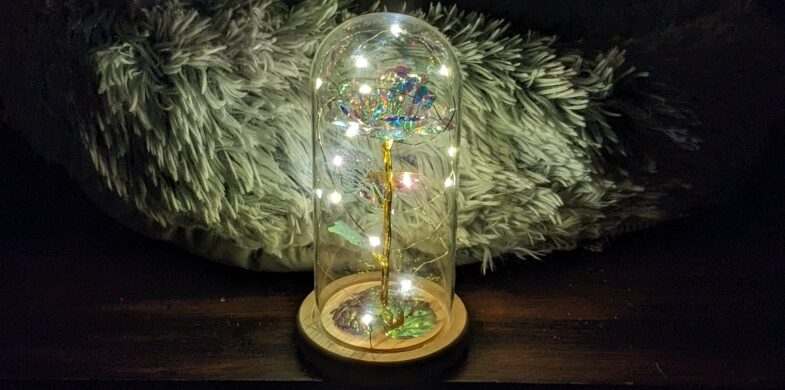
The Apprentice noticed the line of luminescent crystals the first time he stepped into the Wizard’s laboratory. They were on a high shelf, thus he assumed they were valuable or fragile or both, so didn’t ask about them for a very long time.
Between the weary hours of transcription, quests for kings, and alchemical lessons (such as why love potions are, at best, trouble), the Apprentice learned that the Wizard was much kinder than her stern demeanor suggested. As such, one day, between the bubbling of beakers and the scribing of pages, he asked his master, “What are the glowing orbs on your highest shelf?”
“Ah,” the Wizard clucked as she often did when the Apprentice asked difficult questions. “Those would be my mistakes.”
Confusion overcame awe of his instructor, causing the boy to say, “My father always said you shouldn’t drudge up old wrongs.”
“Then your father is a wise. It’s not good to hold onto grievances or flagellate oneself with own’s errors.”
“Then why do you keep them?”
With a heavy sigh, the Wizard retired from her strangely bound grimoire. “Because encased in each of those orbs is a mistake that taught me an important lesson.” In her wizened hand she picked up a rod that she often used in her instruction. The Wizard used it to point at one of the many orbs.
From its surface, the spectral image of a crying young boy with a bloody nose sprang forth. “I learned to be kind because I was cruel.”
She moved the rod to another crystal, from which came the translucent image of a starving family. “I learned to be generous because I was greedy.”
With as much hesitation as the Apprentice had ever seen in the Wizard, she moved the rod to the next. In its depths the boy could see a young woman who very much resembled the Wizard running away, looking over her shoulder in terror at an unseen thing. “I learned to be brave because I was a coward.”
The Apprentice stared at each of the crystals. “It almost seems cruel to keep them.”
“Perhaps it is,” the Wizard conceded, “but there is a part of me that fears if I ever forget the mistake, I will forget the lesson. So, sometimes, late at night, I take them them down from the shelf and arrange them around me. I pick each up in turn to examine them. And as I look at their stupid, tragic beauty, I tell myself: