“Genocide,” began the professor, “was not new nor did it originate in Nazi Germany. If one reads the Old Testament one easily finds evidence that the Hebrews engaged in it, often on the orders of Yahweh, and frequently quite proudly. In Judges you can read of the Israeli leader, Jephthah, calling together the men of Gilead to murder tens of thousands of people using the pronunciation of a word as the sole test for life or death.
What the Nazi regime did was bring genocide into the industrial age. Previous to the rise in Germany, even in World War I, if a tribe, a government, or a political party, wanted to execute an entire people, they had to do it in person, one by one, often by hand.
What the Nazis did was invent ways of killing people, en masse, that had never been seen before, industrializing it through means of production that previously had been used to create rather than murder.”
The professor paused, looking out at his audience of blue-eyed, blonde students. After a moment he ordered, “Discuss.”
“Then why are you trying to find him?” From Simon, the question didn’t come out as judgmental, but admonitory. His expression suggested he could smell the trouble I was getting myself into.
I thought about saying he owed someone money, which may or may not have been true, but it felt too much like a falsehood to share. I went with a stripped down version of the truth. “My boss wants me to find him.”
Simon set the picture back down with a humph. “That should be a job for the police.” He flicked ash from his cigar. “But they do not do that anymore.” I didn’t know if that was official policy or merely an informal practice, but Simon’s statement seemed to indicate some kind of actual experience in the matter. The French police were stretched thin with border control and terrorist watch, with more and more funds going to the gendarmerie every year for these things and little else. Adults searching for adults were told that others had “the right to disappear”.
I watched him smoke. Unable to resist the gravity of this small mystery I asked, “Someone you know vanish?”
Simon crossed one arm along his chest, holding the arm with the cigarillo up by the elbow. Despite the defensive position he frowned intimately and replied, “My son. A long time ago.”
“I didn’t know you were married.”
He chuckled a little then, seeming not able to believe it himself. “Once. Also a long time ago. She died when we were still young and happy.” Simon was no longer looking me in the eye, but staring at the mirror behind me again, wistful and waiting for a ghost. I wondered then if he had somehow sensed the same loss in me, or maybe me in him.
Blinking something out of my eye I decided I had just come for breakfast. In an attempt to move the subject towards what I wanted to talk about I asked, “Has the mobile rung?”
Simon turned his head, putting him into a profile of disinterest. He only shrugged, indicating that even if it had rung he hadn’t bothered to notice.
“May I see it?”
Simon shrugged again, his indifference almost appearing genuine. He got up, though, and walked across the tiled floor to behind the marble counter. A few seconds later he returned with the small flip phone and set it on the table. Opening it I noted it was still charged. If Simon didn’t care about the mobile, he was still kind enough to plug it in for me.
Going over the screen I quickly familiarized myself with its miniature landscape, little more than a digital display of the time and date. In the upper right corner were two icons, one a telephone handset, one like only the oldest hotels in town still had. The other an envelope, which with some fat thumbed navigation I found indicated a text message. It read: “Missed you. Ring back soon.” The ambiguity of the language impressed me – it could have been a message from anyone, a forgotten appointment or an absent lover.
Rather than use the mobile I took note of the phone number and closed the phone. Setting it back down, I thanked Simon, but didn’t explicitly ask him to take the mobile again. Instead I counted out what I owed him for breakfast. I wanted to tip him, but that wasn’t the custom here and he would likely take it as an insult. Instead I ordered something expensive off the menu, then told him I had changed my mind. I paid for it and left before he came back out of the kitchen.
As the light began to turn its way to evening, the flat gray square out in front of the church was filled with tourists and pigeons. Both the birds and the people gathered in small bunches, enjoying the rounded shade of trees or the square profile of the basilica. None of them paid me any mind as I walked through, just a local enjoying a walk once the afternoon rains had passed. The telephone booth was unoccupied, but the telephone in it functioned, which was a continual surprise. I thought about dialing the number from the mobile, but then thought better of it, wondering if Mitnick’s crew might be able to trace it here. While it wasn’t likely, that might compromise the dead drop. Instead I pretended to make a phone call while running my hand along the bottom side of the phone. My finger hit the crinkly edge of something that could have been wrapping paper but was the solid square of a post-it note. I pulled it up and out to read in thin letters of English:
The receding river, pushed far below its normal levels by sustained and terrible drought, had exposed banks that hadn’t been seen in a time immemorial. Among the finding’s Professor Jacobs and his team had made was a round block so long fossilized that they had, at first, assumed it a common stone. However, when it was taken back to the lab with the rest of the excavation’s haul, the professor had discovered it a mummified turtle. It had been buried in the side of the river post-mortem after a series of hieroglyphs had been carved into its shell.
Fascinated by whatever ritual had required such an odd protocol, he set about deciphering the glyphs immediately. Assuming that it was a sacrifice to some unknown river god or a ghastly part of some spring ritual, he instead found an ominous dictum. Into the shell of this ancient tortoise was graven pictographs that translated thusly:
To start at the beginning go here. To hear an audio reading of the chapter, hit the play button below.
When I woke up the women were gone. The silence was so complete that made the walls of the apartment feel thicker, nothing permeating them, not even birdsong from the few windows in the kitchen. The only thing that came through was sunshine filtered to a sepia through the glass stained with years of dirt.
I stumbled around for a few minutes calling for Sophie. Although I was mostly certain it wasn’t the case, there was a part of me that worried she had left with them never to come back. It was one of the few times I regretted the decision not to have mobile phones.
Maybe because that was eating at me, or maybe it was just old-fashioned hunger, that I decided to head to Simon’s and check on the phone I had left with him. Despite all of the noise that this knotted affair was producing, Mitnick was still at the middle of it; the mysterious girl, the casino, the dead man, Atwell. Mitnick seemed to touch all of it. A part of me warned the rest that if Sarti knew about Mitnick, Mitnick might know about my contact with Sarti. I decided to get cleaned up and head that way, regardless.
In the shower, what I was sure was the mostly imaginary smell of the dead Belarusian stuck to me, compelling me to wash out the inside of my nose. Examining the possible motives for the phantom smell, I knew it wasn’t guilt (I hadn’t killed him), or regret (odds were better people had died in worse ways that day), but something I couldn’t quite nail down. On the way to Simon’s whatever it was compelled me to thumb at the passport in my pocket, wondering who he had been and why he had been killed.
On the tram I took it out and examined the document. The name of its former owner had been Sergei Molotov. He had come from Sevastopol to die in a foreign land for sins unknown. He was a big blonde bruiser of a man, seemed to have hunched himself into the small rectangle of the passport photo. He didn’t smile, but his eyes weren’t without humor. That last part felt like biggest difference between the two of us. But then that smell came back and Cheryl’s voice reminded me that Sergei was lying on a slab somewhere and I was in a nice, smooth tram in a sunny country filled with tourists and money.
Trying to shake whatever phantom hold the photo had on me, I spotted an office supply store and hopped off. I went in for a few minutes and was quickly pointed to a copier by squat and tanned young lady whose name tag pronounced her with the unfortunate name of Candida. After making copies of the passport I remembered I had given Sophie the vast majority of the cash. I sighed, wishing I had thought better of it, but was grateful enough that I still had enough to buy breakfast.
Back on the tram, I headed to Simon’s. He had gotten most of the graffiti off his front door. Whatever cleaner he had used left a lighter spot than the rest of it, the corrosive agent having taken the top few layers of wood with it, like some kind of bad tattoo removal. Chairs were stacked up on either side of the door, ready to be carried inside, signaling that it was near the end of the day. Close at hand should any of the neighborhood miscreants decide to get themselves a free chair, Simon stood sweeping the cigarette butts and dropped bits of food from his sidewalk.
After a polite hello and an exchange about our days I asked him if I could still get breakfast. He smiled, pleased that I had thought of his establishment despite my change in hours, and ushered me in. Sat at the back of the cafe, he presented me with a cup of coffee and I asked to borrow some scissors. He nodded, thinking nothing of it, and brought scissors with him when he returned with a small glass of juice. I was cutting the pictures out of the passport copies by the time he had come back with the eggs. He stood there for a moment, holding the plate hostage, eyeing me with an uncustomary curiosity. I couldn’t blame him – the last few days had been strange.
But I could tell he was smiling. Surprisingly, Simon didn’t say anything straight off, but set the plate down and went outside to finish bringing in the last of his chairs. The smell of the eggs, riding that perfect edge between the bland smell of undercooked and the sulfur of overdone, hit me and I set the scissors down. I scarfed the eggs and most of the croissant before Simon returned.
With my thick fingers making the scissors feel like a toy and the cutting like some kind of collage project, Simon’s minor reprobation at the speed of my meal made me feel small. Not accustom or comfortable with this, I returned his stare. His eyes moved off mine towards what I was doing and his expression became one of inquiry. He sat down across from me, produced a cigarillo from his breast pocket and lit it thoughtfully.
Waving out a match he spoke to me in French. “The rains have become less frequent.”
Returning
to my scissor work, I found myself without much to say. “Oui,”
may have been my insightful reply.
My lack of engagement with the usual topic of our French lesson, though, only enabled Simon to ask what was really on his mind. “What are you doing? Do you know this man?” He indicated the photocopies of Sergei with a smoky motion of his hand.
I thought about it, my tongue sticking out in the slightest bit of concentration, focusing on the paper as well as what I could tell Simon. “He’s gone missing,” I said as I freed another Sergei from the borders of his passport.
Simon
took one of the copies, pinning it to the table with his forefinger
and sliding it to him. He examined the dead man’s photo with an
appraising raised eyebrow. “I don’t recognize him.”
“That’s probably for the best,” I said without thinking, causing Simon’s evaluating expression to turn to me. Searching for an explanation I could manage in French I added, “He’s not a good person.” I didn’t know that, of course, but given what I did know, it was the most likely conclusion.
The stories we tell ourselves are importants tool in deciding who we are. We try them on, keeping some, and casting others away. The decisions, and inevitable rebuffs, that create that image may, in fact, be central to the process of determining who we really are This is true for humans and all human endeavors. Whether it’s is a tribe, a country, or a company, the stories we tell each other, from Beowulf to Briar Rabbit, all speak to how we see ourselves and almost always have layered meanings.
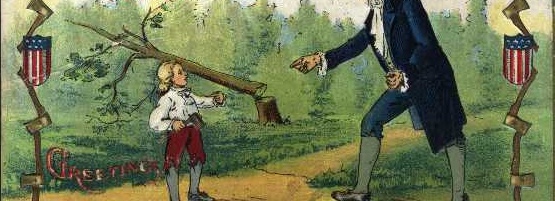
Take, for instance, the tale of George Washington and the cherry tree. In the tale, George Washington ‘cannot tell a lie’ and that is central to the story. The idea is that the founding father of the United States was an honest man and, maybe, this integrity is central to the American character.
But equally important to note is that the Washington of the story doesn’t tell the truth until confronted by a father that (as any parent will attest) most likely already knew who damaged his property. Which brings us to the question, did Washington tell the truth because of innate righteousness? Or because he was practical enough to see that lying would only result in more trouble? Both interpretations are entirely valid. And perhaps both are true.
Like all things of human nature the stories we tell ourselves have a duality that are not always evident upon cursory examination.